
'OMCs are incurring losses of Rs 1,000 crore per day due to the West Asia crisis.'

Government sources indicate a potential increase in petrol and diesel prices due to rising global crude oil costs and losses incurred from a prolonged freeze on retail rates.

The government has dismissed speculation of an imminent increase in petrol and diesel prices, assuring citizens that there are no plans for a hike despite rising crude oil costs.
State-owned Indian Oil Corporation (IOC), Bharat Petroleum Corporation Ltd (BPCL), and Hindustan Petroleum Corporation Ltd (HPCL) are reportedly incurring losses of Rs 18 per litre on petrol and Rs 35 per litre on diesel, as they continue to absorb rising crude oil costs without increasing retail prices. This situation is leading to expectations of a fuel price hike after upcoming state elections.

CNG prices in Delhi have been increased by Re 1 per kg, marking the second increase in less than a week, according to Indraprastha Gas Ltd.

Petrol and diesel prices in India have been increased for the second time in a week, following a long freeze on revisions. The increase comes as global crude prices surge and state-run oil firms look to recoup losses.

Petrol and diesel prices have been increased by Rs 3 per litre each, marking the first hike in over four years, as state-run fuel retailers pass on some of the impact from surging global crude prices, which have been exacerbated by the Iran war.

India possesses two months of fuel stockpiles and faces no supply concerns despite global energy disruptions, according to Oil Minister Hardeep Singh Puri. However, state-run fuel retailers are incurring losses of up to Rs 1 lakh crore in a single quarter due to elevated crude prices and unchanged retail fuel prices, raising questions about the sustainability of these losses.

India's pharmaceutical industry is experiencing increased bulk drug prices, particularly for APIs from China, following the escalation of the West Asia crisis in March. While current inventories provide a temporary buffer, concerns are mounting over the availability of key solvents and feedstocks, potentially leading to manufacturing disruptions and shortages in specific drug categories.

Manufacturers are planning a hike of over 15 per cent in the second quarter of calendar year 2026, as memory prices shoot through the roof.

Indian equity benchmark indices, Sensex and Nifty, tumbled nearly 2 per cent for the fourth consecutive session, driven by elevated crude oil prices, escalating US-Iran tensions, unabated foreign fund outflows, and a depreciating rupee.
Indian equity benchmark indices, Sensex and Nifty, tumbled nearly 2 per cent for the fourth consecutive session, driven by elevated crude oil prices, escalating US-Iran tensions, unabated foreign fund outflows, and a depreciating rupee.

Indian stock markets are poised for volatility this week, driven primarily by the outcomes of five state assembly elections, ongoing high crude oil prices amid West Asia tensions, and the release of Q4 corporate earnings, according to market analysts.

Justin Langer backs Rishabh Pant, saying his Rs 27 crore price tag isn't behind his poor form as Lucknow Super Giants slump to sixth straight defeat in the Indian Premier League.

Aviation fuel prices for domestic airlines remain unchanged, providing stability for local carriers, while commercial LPG and 5-kg cylinders see a significant rate hike due to rising international energy costs.

Jewellery majors Titan Company and Kalyan Jewellers reported robust Q4 FY26 results, with Titan's consolidated revenue surging 81 per cent year-on-year, largely propelled by a sixfold increase in bullion and digital gold sales. Despite strong top-line growth, Titan's gross and operating profit margins faced pressure due to the higher share of lower-margin gold products and increased marketing expenditure.

India's fertiliser subsidy bill for the current financial year (FY27) is projected to increase by approximately 20% due to surging global prices, primarily driven by the West Asia crisis, a senior official confirmed. Despite this, retail prices for urea and di-ammonium phosphate (DAP) will remain unchanged, ensuring adequate supply for the kharif season.

Fast-moving consumer goods (FMCG) companies are closely monitoring crude oil prices and considering low single-digit price increases, while consumer durables firms have already begun passing on significant price hikes to consumers due to rising input costs exacerbated by the West Asia conflict.

Aviation stocks experienced a significant surge following the announcement of a two-week ceasefire between the US and Iran, which led to a sharp decline in crude oil prices. This development has positively impacted stock markets and the broader economic outlook for India.
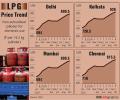
The canteen at the Sports Authority of India's headquarters in Delhi has suspended operations, with the vendor citing LPG supply shortages, while sources suggest pricing disputes are the real issue.

'As re-industrialisation gathers pace across regions like Asia, Europe and the US, a wide range of products and inputs will see demand.'

Aviation Turbine Fuel (ATF) prices have more than doubled to a record high, impacting airlines and consumers, while commercial LPG rates also see a significant increase.

A prolonged supply shock can transmit to lower incomes, and dampen confidence and sentiment, warns Aditi Nayar, chief economist, head-research and outreach, ICRA.

'PM Modi is trying to reduce the volume of fuel consumed instead of raising prices sharply.'
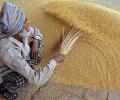
India's wheat and rice reserves in Food Corporation of India (FCI) godowns have surged to 604.02 lakh tonnes as of April 1, nearly three times the mandatory buffer requirement, according to official data.
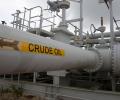
Crude oil prices experienced a significant drop following the announcement of a US-Iran ceasefire and the reopening of the Strait of Hormuz, leading to heavy selling by traders.

Escalating geopolitical tensions in West Asia are beginning to disrupt India's automotive supply chain, leading to rising commodity prices, logistics bottlenecks, material shortages, and pressure on consumer demand, with two-wheeler makers already raising prices.

Despite a sharp increase in import duties on gold and silver to 15 per cent, the precious metals are trading at significant discounts in the domestic market, with gold seeing discounts of up to $200 an ounce and silver up to $6 an ounce.
The canteen at the Sports Authority of India's headquarters in Delhi has suspended operations due to a vendor complaint about LPG supply shortages, though sources suggest pricing disputes are also a factor. This closure primarily affects staff, as athletes' meals are provided separately.

If the conflict continues for a prolonged period, State-run oil companies may have to review retail fuel prices accordingly.
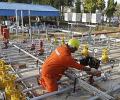
State-run oil-marketing companies (OMCs) are unlikely to significantly raise petrol and diesel prices despite crude oil nearing $100 a barrel, leading to potential margin pressure, while CLSA analysts project a 65 per cent upside for ONGC's stock.

Foreign Portfolio Investors (FPIs) have withdrawn Rs 27,048 crore from Indian equities so far in May, bringing the total outflows for 2026 to Rs 2.2 lakh crore, driven by global macroeconomic and geopolitical uncertainties.

Civil Aviation Minister K Rammohan Naidu announced that public sector oil marketing companies will implement a partial and staggered increase in jet fuel prices for domestic airlines, aiming to protect passengers from steep fare hikes.

Major paint companies in India, including Asian Paints, Berger Paints, Akzo Paints, and Kansai Nerolac, have announced price hikes ranging from 1% to 8% across various product lines, effective from mid-March to late April, in response to persistently high crude oil and gas prices.

Indian investors have seen their wealth erode by a staggering Rs 16.77 lakh crore over four trading sessions, as the markets faced deep losses driven by elevated crude oil prices, geopolitical tensions, persistent foreign fund outflows, and a record-low rupee.

India emerged reasonably well from 2025. But now, the oil shock and war-related supply disruptions have again driven funds out of India and significantly weakened the rupee, points out Ajay Chhibber.

Markets face risk of a prolonged bear phase as oil shocks and geopolitical tensions test inflation, growth and investor confidence globally, points out Debashis Basu.

Analysts predict that developments in West Asia and their impact on crude oil prices will heavily influence investor sentiment in the upcoming week. Global market trends, foreign investor activity, and rupee-dollar movement will also play a role.

The Indian rupee plummeted to an all-time low of 95.80 against the US dollar, settling at 95.66, driven by elevated crude oil prices and escalating geopolitical tensions in West Asia, despite potential RBI intervention and import curbs on gold.

Airfares to Southeast Asia have surged 25 to 30 per cent, driven by high demand and limited airline seat capacity.
 © 2026 Rediff.com - Advertise with us - Disclaimer - Privacy Policy - Sitemap - Feedback - About us - Terms of use - Grievances